Mind Game
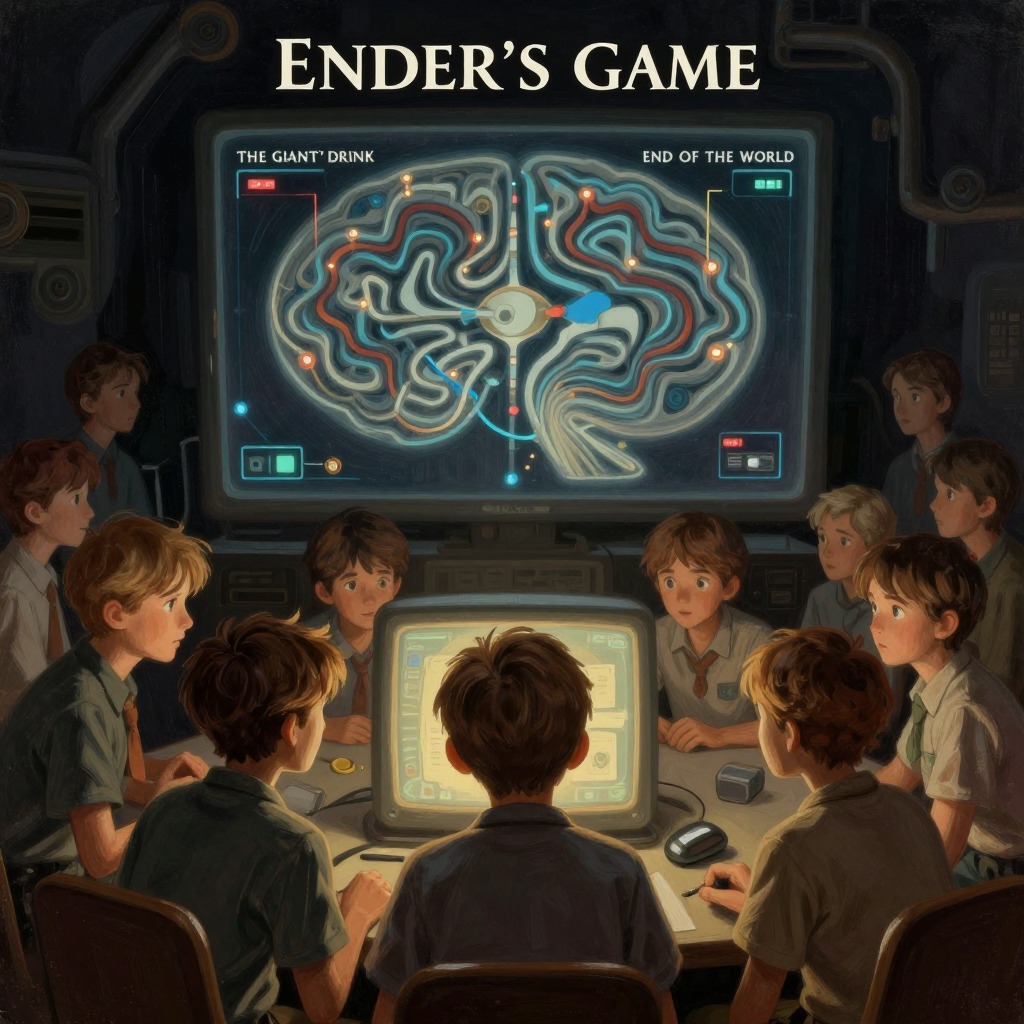
The Mind Game is the adaptive computer simulation at Battle School that shapes each child's psychological profile through interactive scenarios, most notably the Giant's Drink, Fairyland, and the End of the World. It serves as both a training tool and a diagnostic instrument, revealing Ender Wiggin's deepest fears, desires, and moral conflicts, and ultimately foreshadows his role as the commander who unknowingly destroys the bugger homeworld.
Design and Purpose
The Mind Game is introduced to Ender during his private study time at Battle School, described as a "shifting, crazy kind of game in which the school computer kept bringing up new things, building a maze that you could explore." It is a free-play environment where the child's figure can transform—Ender's starts as a little boy, changes into a bear, and then into a large mouse with long, delicate hands. The game is not merely entertainment; it is a diagnostic tool that the teachers monitor closely. Colonel Graff and Major Anderson discuss Ender's progress in the game, noting that he is "stuck at the Giant's Drink" and that "everybody gets the Giant sometime," but Ender's persistence is unusual. The game is designed to help shape children, as Major Imbu explains: "The mind game is a relationship between the child and the computer. Together they create stories. The stories are true, in the sense that they reflect the reality of the child's life." This adaptive nature means the game responds to the child's psyche, creating scenarios that mirror their inner conflicts.
The Giant's Drink and Fairyland
The most prominent scenario is the Giant's Drink, where a giant offers Ender two shot glasses, one containing poison and the other not, promising to take him to Fairyland if he guesses correctly. Ender repeatedly dies in gruesome ways—his head dissolves, he catches fire, he drowns, or he rots away—and the Giant always laughs. The game is rigged; Ender knows that "whatever he chose he would die." This scenario tests his persistence and his response to inevitable failure. In a pivotal moment, Ender refuses to play by the rules: instead of drinking, he kicks over both glasses, dodges the Giant's hands, climbs up his face, and burrows into his eye, killing him. This act of defiance, of "cheating" the game, leads him to Fairyland, where a bat welcomes him. However, Ender is disturbed by his own violence, thinking, "I'm a murderer, even when I play. Peter would be proud of me." This reaction reveals his deep-seated fear of becoming like his brother Peter, a fear that the game exploits.
The End of the World and the Mirror
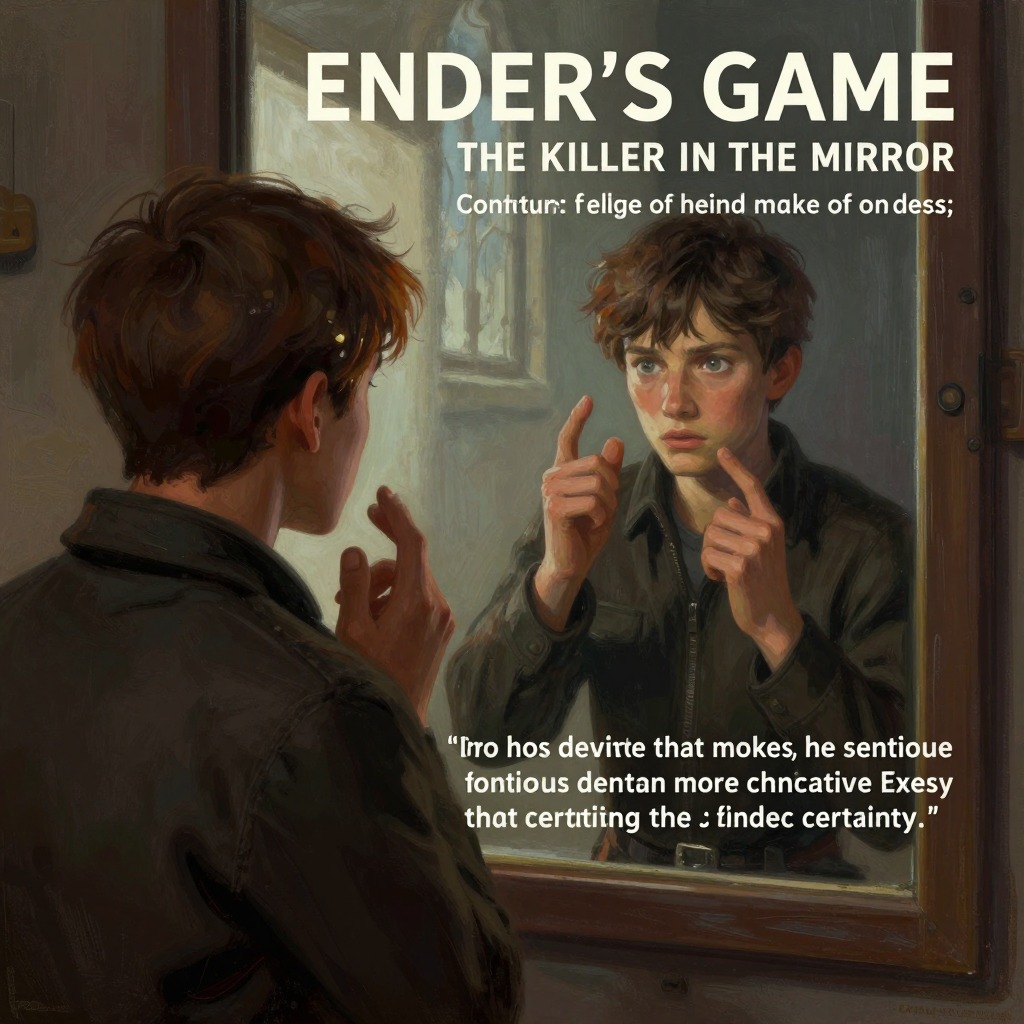
After the Giant's death, Ender explores Fairyland and eventually reaches a place called the End of the World, a beautiful pastoral landscape with a castle. In the castle tower, he encounters a serpent that unravels from a rug, and a mirror that reflects the face of Peter, with blood dripping down his chin and a snake's tail protruding from his mouth. This image haunts Ender, symbolizing his fear that he is becoming a killer like Peter. The game's ability to conjure Peter's face—a recent photograph, not from Battle School files—alarms the teachers, who realize the computer has requisitioned it from a landside computer, indicating the game's deep access to Ender's psyche. Ender repeatedly tries to escape the tower, but every attempt ends in death, whether by drowning, being bitten by snakes, or other means. He feels "trapped at the End of the World with no way out," a metaphor for his despair and lack of control over his life.
The Kiss and Resolution
In a crucial turning point, after receiving a letter from Valentine that the teachers had orchestrated, Ender returns to the tower. Instead of killing the snake, he gently brings its mouth to his lips and kisses it. The snake transforms into Valentine, and together they walk down a stairway lined with cheering multitudes, all wearing Peter's face. This act of acceptance and love, rather than violence, breaks the cycle of death and allows Ender to move forward. The game's resolution reflects Ender's emotional growth and his ability to reconcile his fear of becoming Peter with his love for Valentine. The teachers note that Ender has "won everything" in the game, and it is no longer a challenge for him.
Significance and Legacy
The Mind Game serves as a microcosm of Ender's entire journey. It mirrors his battles in the Battle Room and his ultimate command of the fleet, where he unknowingly destroys the bugger homeworld. The game's scenarios—the Giant's Drink, the End of the World, the mirror—are later echoed in the real world when Ender discovers the bugger queen's cocoon in a tower that replicates the game's landscape. The game's ability to tap into Ender's mind, to show him his darkest fears and his capacity for both violence and love, makes it an essential tool for the teachers to shape him into the commander they need. It also highlights the ethical dilemma of using children as weapons, as the game manipulates Ender's emotions and moral compass for military purposes. Ultimately, the Mind Game is not just a training simulation but a psychological mirror that reveals the cost of Ender's genius and the burden he carries.